
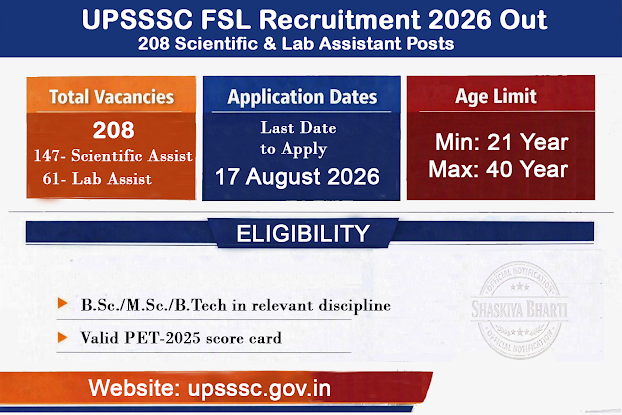
The Uttar Pradesh Subordinate Services Selection Commission has officially released the UPSSSC FSL Forensic Science Laboratory Recruitment 2026 - notification for a total of 208 vacancies. These posts include Scientific Assistant (General & Special Selection) and Lab Assistant (General & Special Selection) under the Forensic Science Laboratory, Lucknow. This recruitment drive is a major opportunity for candidates with a background in Biology, Physics, Chemistry, and Computer Science, as the positions demand specialized knowledge in forensic applications.
For UPSSSC FSL recruitment 2026 the online application process begins on 27 July 2026 and will remain open until 17 August 2026, with the last date for fee payment and corrections set as 24 August 2026. Candidates must first complete their One‑Time Registration (OTR) and hold a valid PET‑2025 score to be eligible for applying. The recruitment follows the UP Forensic Science Laboratory Subordinate (Technical) Service Rules, 2016, ensuring transparency and merit‑based selection. Applicants will undergo shortlisting through PET scores, written examination, medical test, and document verification.
UPSSSC FSL Forensic Science Laboratory Recruitment 2026 |
|
|
Recruiting
Body
|
Uttar
Pradesh Subordinate Services Selection Commission (UPSSSC)
|
|
Advertisement No.
|
|
|
Posts
|
Scientific
Assistant & Lab Assistant (Forensic Science Laboratory)
|
|
Total Vacancies
|
208 (Scientific Assistant – 147, Lab Assistant – 61)
|
|
Application
Dates
|
27 July
2026 – 17 August 2026
|
|
Correction Window
|
Till 24 August 2026
|
|
Eligibility
|
B.Sc./M.Sc./B.Tech
in relevant discipline + Valid PET‑2025 score card
|
|
Selection Process
|
PET‑2025 Score Shortlisting → Written Exam → Medical Exam
→ Document Verification
|
|
Age
Limit
|
21–40
years (as on 01.07.2026) with relaxations as per UP Govt. rules
|
|
Application Fee
|
₹25 (all categories, online payment)
|
|
Salary
|
• Scientific
Assistant – Level‑6 ₹35,400 – ₹1,12,400 • Lab Assistant – Level‑4 ₹25,500 –
₹81,100
|
|
Job Location
|
Forensic Science Laboratory, Lucknow & units across
Uttar Pradesh
|
|
Website
|
|
UPSSSC FSL FORENSIC SCIENCE LABORATORY RECRUITMENT 2026 VACANCIES
|
S.N.
|
Post
Name
|
Pay
Level
|
UR
|
SC
|
ST
|
OBC
|
EWS
|
Total
|
|
1
|
Scientific
Assistant – Forensic Science Laboratory, Lucknow
|
Level‑6
₹35,400 – ₹1,12,400
|
54
|
28
|
02
|
37
|
13
|
134
|
|
2
|
Scientific Assistant (Special Selection) – Forensic
Science Laboratory, Lucknow
|
Level‑6 ₹35,400 – ₹1,12,400
|
–
|
05
|
02
|
06
|
–
|
13
|
|
3
|
Lab
Assistant – Forensic Science Laboratory, Lucknow
|
Level‑4
₹25,500 – ₹81,100
|
23
|
12
|
01
|
15
|
05
|
56
|
|
4
|
Lab Assistant (Special Selection) – Forensic Science
Laboratory, Lucknow
|
Level‑4 ₹25,500 – ₹81,100
|
–
|
02
|
00
|
3
|
–
|
05
|
Some Other Reservation based posts
|
S.
N.
|
Department
|
Post
Name
|
FF
|
B
|
D
|
CS
|
MD
|
RS
|
W
|
SP
|
|
1
|
Office
of Forensic Science Laboratory, Uttar Pradesh, Lucknow
|
Scientific
Assistant (O.L., Dw, A.A.V.)
|
02
|
–
|
–
|
05
|
–
|
06
|
26
|
02
|
|
2
|
Office of Forensic Science Laboratory, Uttar Pradesh,
Lucknow
|
Scientific Assistant (Special Selection) (O.L., Dw,
A.A.V.)
|
00
|
–
|
–
|
00
|
–
|
00
|
02
|
00
|
|
3
|
Office
of Forensic Science Laboratory, Uttar Pradesh, Lucknow
|
Lab
Assistant (Laboratory Assistant) (O.L., Dw, A.A.V.)
|
01
|
–
|
–
|
02
|
–
|
02
|
11
|
01
|
|
4
|
Office of Forensic Science Laboratory, Uttar Pradesh,
Lucknow
|
Lab Assistant (Special Selection) (Laboratory Assistant)
(O.L., Dw, A.A.V.)
|
00
|
–
|
–
|
00
|
–
|
00
|
01
|
01
|
- SP –
Sports Person
- W –
Women
- Ex –
Ex-Servicemen
- FF –
Freedom Fighter
- CS
– Cerebral Stroke
- M –
Mental or Intellectual Disability
- D –
Deaf
- B –
Blindness
UPSSSC FSL FORENSIC SCIENCE LABORATORY RECRUITMENT 2026 – ELIGIBILITY
The eligibility criteria for UPSSSC Forensic Science Laboratory Recruitment 2026 define the minimum
educational qualifications and age requirements that candidates must meet to
apply.
|
Post
Name
|
Mandatory
Qualification
|
Preferred
Qualification
|
|
Scientific
Assistant (Biology / Physics / Chemistry / Computer Science)
|
- B.Sc.
in relevant subject (Biology, Physics, Chemistry) with specialization as per
rules OR - B.Tech. in Instrumental Electrical & Electronics / Civil /
Mechanical (for Physics domain) OR - Bachelor’s in Computer Science /
B.E./B.Tech. in CS/IT / NIELIT ‘A’ Level Diploma
|
- M.Sc.
in relevant subject (Biology/Physics/Chemistry) - Higher qualification in
Computer Science - Territorial Army service (minimum 2 years) - NCC ‘B’
Certificate
|
|
Lab Assistant (Biology / Physics / Chemistry / Computer
Science)
|
- B.Sc. in relevant subject (Biology, Physics, Chemistry)
with specialization as per rules OR - Bachelor’s in Computer Science / NIELIT
‘A’ Level Diploma
|
- Territorial Army service (minimum 2 years) - NCC ‘B’
Certificate
|
UPSSSC FSL FORENSIC SCIENCE LABORATORY RECRUITMENT 2026 AGE LIMIT
|
S.N.
|
Department
/ Post Name
|
Age
Limits & Relaxation
|
|
1
|
Forensic
Science Laboratory, Uttar Pradesh, Lucknow – Scientific Assistant
(General & Special Selection)
|
As
per UP Forensic Science Laboratory Subordinate (Technical) Service
Rules, 2016 – Part‑4 Rule‑10: • Candidate must have attained 21
years of age on 01 July of the calendar year in
which vacancies are advertised. • Candidate must not have attained 40
years of age on that date. • For SC, ST, OBC, and other categories
notified by the Government, the upper age limit shall be relaxed by
the number of years specified in the notification.
|
|
2
|
Forensic Science Laboratory, Uttar Pradesh, Lucknow
– Lab Assistant (General & Special Selection)
|
As per UP Forensic Science Laboratory Subordinate
(Technical) Service Rules, 2016 – Part‑4 Rule‑10: • Candidate must have
attained 21 years of age on 01 July of the
calendar year in which vacancies are advertised. • Candidate must not have
attained 40 years of age on that date. • For SC, ST, OBC,
and other categories notified by the Government, the upper age limit
shall be relaxed by the number of years specified in the
notification.
|
READ: MP Teacher Vacancy 2026 Notification, 30,000 Posts Varg 1 to Varg 3
UPSSSC FSL FORENSIC SCIENCE LABORATORY RECRUITMENT 2026 SYLLABUS
The syllabus for UPSSSC FSL Recruitment 2026 is designed to evaluate candidates’ subject
expertise, computer knowledge, and awareness of Uttar Pradesh. It is divided
into three parts:
Part‑1: Subject Related Knowledge
Physics
- Mechanics
– Units, dimensions, scalars, vectors, motion, Newton’s laws, work,
energy, power, gravitation, collisions, rotational motion, SHM,
elasticity, viscosity.
- Heat
& Thermodynamics – Temperature, thermal expansion, laws of
thermodynamics, heat transfer, kinetic theory, specific & latent heat.
- Waves
& Sound – Wave motion, resonance, Doppler effect, ultrasonics.
- Optics
– Reflection, refraction, lenses, optical instruments, interference,
diffraction, polarization, LASER, fiber optics.
- Electricity
& Magnetism – Coulomb’s law, electric field, potential, capacitance,
current electricity, Ohm’s law, Kirchhoff’s laws, magnetic field,
induction, AC, transformers.
- Electronics
– Semiconductors, diodes, transistors, rectifiers, amplifiers, digital
electronics, logic gates, communication systems.
- Modern
Physics – Atomic structure, Bohr’s model, photoelectric effect, X‑rays,
radioactivity, nuclear reactions, lasers, holography.
- Radiation
& Nuclear Physics – Radioactive decay, detectors, GM counter,
scintillation detector, radiation safety.
- Applied
Physics in Forensics – Microscopy, spectroscopy, chromatography, imaging,
ballistics, fingerprint imaging, UV & IR applications.
- Experimental
Physics & Instrumentation – Vernier calipers, screw gauge, error
analysis, measurement techniques, electrical instruments.
Chemistry
- Physical
Chemistry – Atomic structure, bonding, states of matter, thermodynamics,
equilibrium, kinetics, electrochemistry, solutions.
- Organic
Chemistry – Isomerism, hydrocarbons, alcohols, ethers, aldehydes, ketones,
acids, amines, polymers, biomolecules, aromatic compounds, named
reactions.
- Inorganic
Chemistry – Periodic table, coordination compounds, p‑, d‑, f‑block
elements, metallurgy, qualitative analysis.
- Analytical
Chemistry – Volumetric & gravimetric analysis, buffers, pH, titration,
chromatography (TLC, GC, HPLC), spectroscopy (UV, IR, Mass, AAS).
- Forensic
& Applied Chemistry – Toxicology, narcotics, explosives, petroleum,
paints, dyes, fibers, poison analysis, alcohol estimation, food
adulteration, arson investigation.
- Biochemistry
– Proteins, enzymes, carbohydrates, lipids, vitamins, nucleic acids,
metabolism.
- Environmental
Chemistry – Water, air pollution, heavy metals, waste management.
- Instrumentation
– Spectrophotometer, calorimeter, centrifuge, microscope, electrophoresis,
PCR basics.
Biology
- Cell
Biology – Structure, organelles, division, cycle, transport.
- Genetics
– Mendel’s laws, DNA/RNA, protein synthesis, mutation, disorders, genetic
engineering.
- Molecular
Biology & Biotechnology – DNA fingerprinting, PCR, electrophoresis,
recombinant DNA, cloning, HGP, applications.
- Human
Anatomy & Physiology – Digestive, respiratory, circulatory, nervous,
excretory, endocrine, reproductive, skeletal, muscular systems.
- Blood
& Serology – Blood composition, groups, antigen‑antibody, stains,
tests.
- Microbiology
– Bacteria, viruses, fungi, protozoa, sterilization, culture.
- Immunology
– Immune system, antibodies, vaccines, autoimmunity.
- Biochemistry
– Carbohydrates, proteins, lipids, enzymes, vitamins.
- Forensic
Biology – Evidence collection, hair, semen, saliva, DNA profiling, human
ID, wildlife forensics, entomology, age/sex determination.
- Ecology
& Environment – Ecosystem, biodiversity, pollution, conservation.
Mathematics
- Arithmetic
– Number system, ratio, percentage, profit/loss, SI/CI, averages,
time/work, speed/distance.
- Algebra
– Identities, linear/quadratic equations, polynomials, logarithms, AP, GP.
- Geometry
& Mensuration – Triangles, circles, coordinate geometry, surface area,
volume.
- Trigonometry
– Ratios, heights/distances, identities.
- Statistics
– Mean, median, mode, SD, variance, probability, data interpretation.
- Analytical
& Logical Reasoning – Series, coding, blood relations, puzzles,
syllogism, seating, Venn diagrams.
- Advanced
Topics – Permutation, combination, matrices, determinants, calculus
basics.
Forensic Science
- General
– Definition, history, scope, ethics, QA/QC, Frye & Daubert standards.
- Crime
Scene Investigation – Management, search methods, documentation, evidence
collection, chain of custody.
- Evidence
– Physical, biological, trace, digital; hair, fibers, glass, paint, soil,
fingerprints, blood, DNA.
- Forensic
Biology & Toxicology – Blood grouping, DNA extraction, poisons,
toxicology, narcotics, alcohol.
- Forensic
Chemistry – Explosives, petroleum, arson, chromatography, spectroscopy.
- Questioned
Documents – Handwriting, signatures, forgery, ink/paper, counterfeit
detection.
- Ballistics
& Physics – Firearms, ammunition, ballistics, gunshot residue, tool
marks.
- Cyber
& Digital Forensics – Computers, cyber crimes, digital evidence,
recovery, mobile forensics, IT Act basics.
Part‑2: Computer & IT Concepts
- History,
introduction, applications of computers & IT.
- Hardware
& software basics.
- Input/output
devices.
- Internet
protocols, IP address.
- IT
gadgets & applications.
- Email
creation & usage.
- Operation
of printer, tablet, mobile.
- MS‑Word
& MS‑Excel basics.
- Operating
systems, social networking, e‑Governance.
- Digital
financial tools & applications.
- Cyber
security, future skills.
- Emerging
technologies: AI, Big Data, Deep Learning, Machine Learning, IoT.
- India’s
achievements in IT.
Part‑3: General Knowledge of Uttar Pradesh
- History,
culture, art, architecture, festivals, folk dances, literature, languages.
- Heritage,
social customs, tourism.
- Geography,
environment, natural resources, climate, soil, forests, wildlife,
minerals.
- Economy,
agriculture, industry, business, employment.
- Polity
& administration.
- Current
events & achievements of Uttar Pradesh in various fields.
UPSSSC FSL FORENSIC SCIENCE LABORATORY RECRUITMENT 2026 SELECTION PROCESS
- Written
Examination
- Candidates
will appear in a competitive written test.
- The
exam will cover subject knowledge (Biology, Physics, Chemistry, Computer
Science), analytical ability, and general aptitude.
- Document
Verification
- Shortlisted
candidates must present original certificates.
- This
includes educational qualifications, caste/reservation certificates, and
proof of NCC/Territorial Army service (if applicable).
- Interview
/ Skill Test (if applicable)
- For
certain posts, an interview or skill test may be conducted.
- This
stage evaluates practical knowledge, communication skills, and
suitability for the role.
- Merit
List Preparation
- Final
merit will be prepared based on written exam performance and
interview/skill test (if conducted).
- Preference
will be given to candidates with higher qualifications (M.Sc., advanced
Computer Science), NCC ‘B’ Certificate, or Territorial Army service.
- Appointment
- Selected
candidates will be appointed to the respective posts in the Forensic
Science Laboratory, Uttar Pradesh.
- Appointments
will be made as per rules and availability of vacancies.
HOW TO APPLY for UPSSSC OTR REGISTRATION 2026 & UPSSSC FSL 2026
To apply for UPSSSC OTR (One‑Time Registration) 2026, you
need to create a permanent profile on the UPSSSC portal. This profile stores
your personal, educational, and contact details, and generates a unique OTR
number that you’ll use for all future PET and recruitment applications.
|
Step
|
Action
|
Details
|
|
1.
Visit Official Portal
|
Go to
the UPSSSC OTR Registration Page
|
Official
website: upsssc.gov.in → Click on “OTR
Registration” link
|
|
2. Create Profile
|
Enter personal details
|
Candidate’s name, father’s/mother’s name, date of birth,
gender, category, domicile, Aadhaar number
|
|
3.
Contact Verification
|
Verify
mobile & email
|
OTP
will be sent to your registered mobile number and email ID for confirmation
|
|
4. Educational Details
|
Fill academic qualifications
|
High School, Intermediate, Graduation/Post‑Graduation,
Technical qualifications (if any)
|
|
5.
Upload Documents
|
Upload
scanned files
|
Recent
passport‑size photo, signature, and relevant certificates in prescribed
format
|
|
6. Final Submission
|
Review & lock profile
|
Once submitted, details cannot be edited. A unique OTR
Number will be generated
|
|
7.
Use OTR Number
|
Apply
for PET & recruitments
|
This
OTR number will be used for all future UPSSSC applications (PET, mains,
direct recruitments)
|
step‑by‑step guide for applying to UPSSSC FSL Forensic Science Laboratory Recruitment 2026 after completing
your OTR registration:
- Login with OTR number
- Use your OTR credentials to log in to the UPSSSC application portal.
- Select recruitment notification
- Click on the active advertisement for UPSSSC FSL Forensic Science Laboratory Recruitment 2026.
- Fill
Application Form
- Your OTR details will auto‑populate; add post preferences, category, and other required information.
- Upload Documents
- Attach scanned photo, signature, and certificates in the prescribed format and size.
- Pay
Application Fee
- Submit the required fee online through net banking, card, or UPI as per category.
- Submit
& Print
- Submit
the form online.
- Download
and print the application acknowledgment slip for future
reference.
UPSSSC FSL FORENSIC SCIENCE LABORATORY RECRUITMENT 2026 IMPORTANT DATES
The UPSSSC FSL Forensic Science Laboratory Recruitment 2026 application window is already start from 27 July 2026 and ends on
17 August 2026, with fee payment and correction allowed until 24 August 2026.
|
Event
|
Date
|
|
Notification
Release
|
24 July
2026
|
|
Online Application Start
|
27 July 2026
|
|
Last
Date to Apply Online
|
17
August 2026
|
|
Fee Reconciliation & Correction Window
|
24 August 2026
|
|
Written
Examination
|
To be
announced (after shortlisting via PET‑2025)
|


